Thursday, October 9, 2008

What Meditation Does to Your Brain

Following up on the previous blog about meditation, I've been digging around for some interesting links on how meditative states correlate with brain waves. Here's a basic rundown on how:


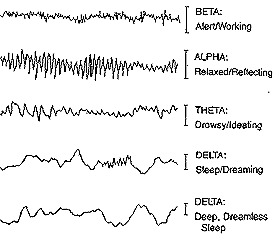
(Graph from crystalinks)

The brain itself emits electromagnetic energy, and this brain activity differs according to its state (sleeping, awake, thinking etc). There is a growing amount of data about these brain states, specifically on how the act of meditation influences them. According to this chart, beta waves coincide with thinking/working/ activities, while on the other side of the spectrum there is delta, which indicates deep and dreaming/dreamless sleep. Meditation is often found with alpha/theta waves. I'd be curious to know where mindfulness meditation fits in this spectrum.

There are various sound waves that induce or help promote a particular brain state. Ever hear of the brainwave generator? It's been around for a few years now (at least). You can download the program, free and try it out. It has a very extensive list of different sounds which allegedly help for a number of tasks, from meditating to headaches. What are your thoughts on it? From giving it a shot, I admit it did induce something. I've tried it to help write papers, but I've found myself having to make an active effort to first clear out all other sounds, sit back and take it in. There does seem to be some kind of effect, for sure. I'm just not sure how extensive it is.

Next up on the list is Holosync. This project is by far a more extensive one. I haven't purchased the program, but there seems to be alot of positive hype about it. What I did manage to get is a demo CD. It did seem to have some effect, but not as strong as the Brainwave generator. This could have been because the Holosync CD had the president speaking for a good majority of the demo, while the sound waves played underneath. I found it to be a bit distracting.

Without making this too patchy, I think I'll end it here, and in the next blog (part 2) I'll dive into a related topic: the science behind meditation. There are a handful of really interesting experiments and debates over meditation and the brain. Stay tuned!


Friday, October 3, 2008

10 Tips for Effective Meditation


1. Daily Practice. Meditation doesn't necessarily mean taking a few hours out of your day. In fact, morning and evening meditation can fit easier into your schedule. Try simple breathing exercises after you lie down to fall asleep. When you wake up, spend a few minutes with the same breathing exercises. A regular mindfulness practice will gradually spill over to your every-day life. You'll notice yourself going back into that "flowing" state during the day.
2. Mindfulness. Whether or not you have more time, mindfulness can be applied throughout the day. Simply notice things, pay attention to your breathing while you walk. Notice simple and subtle bodily aspects-- emotional and physical reactions. Simply notice your thoughts as they arise. Watch the world arise and fall as you move through it. Once again, a daily practice is the most important for effectiveness.
3. Follow the breath. Inhale through your nose, feel the air fill your lungs, feel the air leave. Beginners are encouraged to count 1-10 to help keep the pace. Once you are comfortable, quietly follow the breath. This is tricky to do at first, but it is the foundation of meditation. Gradually it will become more natural for you. When you first start, don't worry about the thoughts that pop up. Just keep following the breath. When you lose count, or get distracted, quietly pause and then begin the count again.
4. Read. Digging into a good book may stimulate your thoughts, but it also may stimulate meditative states. Reading Tao te Ching, Krishnamurti or even Eckhart Tolle can help trigger you into reflective, mindful states. Reading blogs, links and anything on the internet is good for stimulating your mind and encourage self reflection.
5. Exercise. Physical meditation, you could call it. Mindfulness during physical exertion is sometimes one of the most effective ways to meditate. It lets you both be physically healthy and more aware of your body in motion. Meditation is not just about "sitting still" - that is, not just literally. It's also finding the still point while in motion.
6. If you're feeling negative emotions-- good! Or, in other words, when anxiety, anger, fear, etc. pop up during your practice, it means you are peeling off the layers and noticing things that have been brushed aside. When these feelings do arise, don't try to fix them. Just be with them, notice them and observe them. Just like you are doing with your body. This simple acceptance of their presence is sometimes the most important thing you could do for your mental and emotional well being.
7. Don't push yourself! No, really. One of the most difficult things many beginners and long time meditators experience is frustration. How can you "stop" yourself from thinking? Well, the trick is it can't be forced. If you are having trouble focusing, just notice that. If your thoughts wander, do your best to accept that and simply observe them as they stray. Once again, this bare attention is vital to a fruitful meditation practice.
8. Practice Compassion. For those of you who would like to try a more hands-on, creative approach to meditation. This form of meditation is compassion practice. Start by following the breath. After a minute or two, begin to imagine the world. Start with loved ones, and then go out to greater and greater points of view. Imagine any sickness, physical or emotional pain. As you breathe in, inhale that pain. If it helps, conceive of that pain as dark tar or black smoke. When exhaling, imagine letting that pain and sickness go into an infinite, unconditional love. You can imagine that love as an infinite blue sky or white light. Do this for 10-15 minutes a day. The results may be surprising!
9. Eat right. A healthy diet can make all the difference for your mental health. It helps attentiveness, awareness and general mental/physical strength. Not to mention-- sleep right too!
10. Music and environment helps. The right ambient (or any music, mind you) sounds can help stimulate mindfulness. Also, the right environment can help you too. A quiet day with the window open, spring or even winter air can help you induce a state of meditation. Music, it almost goes without saying, is an extremely potent tool. Don't be ashamed to try meditation CD's either!

That's it for now. Stay tuned for a follow up blog on meditation, brain waves, and Holosync.


Thursday, October 2, 2008

Thoughts on the Bailout, a Clue from Duck Tales


I'm sure everyone has been following this. This is a post from Reddit: a video of Duck Tales teaching kids the laws of economics-- borrowing too much loses value! It's stunning, and almost prophetic how this video could serve as a reminder and an informer for everyone, especially those responsible for creating the bailout. To me, it really seems like it's just delaying the inevitable. Patchwork on a breaking car. Do we really think that adding more debt to save us from debt works? I swear, I may be young, but how is it that leaders of multi national corporations can't seem to get this right?

This is where it gets cloudy, but it sounds like it's a matter of policy. The philosophy of "trickle down" doesn't work. I think this is partially to do with our nature. People are greedy. They keep the money. Some things are complex only because we dodge the reality of things. Is there a way to change our policy? Can there be a system that takes human nature into better account?

Following up on that, here's a graphical representation of US debt over the past 10 years.


Monday, September 29, 2008

What does integral look like?


(Cross-post from the Integral pod on Gaia)

This is a thought that's been cooking for a while: how will integral naturally emerge, and will it look like the way Wilber has described it?

I might be wrong, but from reading wilber, I get the impression one of the main characteristics of integral is vertical thinking, developmental awareness. deeper levels of understanding. I do think this is an important characteristic, but what people seem to be witnessing is a deeper, complex way of thinking, yet seen as a horizontal complexity. It's still development, but not quite “linear” as it used to be.

Or in other words, the heirarchy, the classical “beaurocratic” levels are breaking down for a networking society.

So we're seeing the rise of the “network” instead of the “institution.” there are alot of thinkers along these lines, and to me this seems like where civilization is headed. i think this fits perfectly into integral, without needing to structure in levels just yet. it can fit into the maps, for sure, but common understanding of 'vertical' development is something that doesn't need to happen first. instead, we are re-thinking and seeing the relationship and organization in a totally new, complex structure.

We're seeing a breakdown of classical institutions, the information age has created collaborative efforts, open source organizations— and the internet is the best place to see new structures of society emerging.

So, what does integral look like, without the language, without the theory? or in other words, what does it look like without the map?

Networks, organic patterns, collaborations and decentralized organization.

I think Wilber, and many other integral theorists have correctly criticized “flatland,” and postmodernism for simply accepting the break down of heirarchy, centralized ways of thinking as the end-all, be-all. The story doesn't stop there. But instead of immediately creating vertical maps, it seems that it is naturally happening by first seeing organic patterns in the chaos. people are structuring naturally, organizing and networking. this way, underlying themes begin to be seen… and yes, maybe eventually we will have a deeper vertical awareness. for the moment, the depth comes from understanding the space between perspectives, but we're in the midst of creating the map. relationship and flex-flow will become prominent– and this is resonant with spiral dynamics, the 2nd tier “integral” value memes. If Wilber, and many of the integral theorists are correct, we will see maps arise naturally, and the “integral” attitude arising naturally in many creative ways.

If you want to see where it's headed, I think some great thinkers who are not associated with the integral theorists, per say, are clay shirky, who has an excellent ted talk here: Institution vs Collaboration

Another thinker is Manuel Castells– a sociologist who is strongly for moving beyond postmodernism, and wrote a book called “The Rise of the Network Society,” as well as “1000 Years of Non-Linear History.”

Do you know of any others? i'm not sure this is all coherent, but what i'm trying to get at is that we're seeing “integral” pop up organically, and sometimes the language of these theories can get in the way from seeing the seeds grow right under our feet.

Reading List!


Just picked up this book,

Commentaries on Living, First Series.

It's an excellent book, and very memorable for me. I used to read it on bus rides in high school. Good old days! Does that make me seem old? Here are a few other books I've picked up lately. Book reviews to come shortly...

And secondly, this great book. Another classic,


No Boundary: Eastern and Western Approaches to Personal Growth

I've read this one in the past, and it's great-- way before Wilber got a little heavy with the metaphysics. When does meaning become lost in the very language that is supposed to convey it? I think this is an important question, especially for the philosopher, the scientist, and the spiritualist. Sometimes, the simpler way is the most effective. What are your thoughts?

And finally, Eckhart Tolle: A New Earth. This book has been a popular one in the mainstream, and so far it seems to be eloquently simple, yet descriptive enough to reach some deep issues. I know some people are calling Tolle just another fake, someone cashing in on feel-goodness and such. I cannot say the same. His writing is on-par with alot of spiritual and philosophical thinkers, including the afformentioned Krishnamurti. In a sense, he is able to simplify complex meaning to common day language, and disseminate it to the majority of the population. So much so, he's got this show on Oprah's website. I can't say this does more harm than good. If anything, it at least gets people reflecting. That's something these days, no?

Sunday, September 28, 2008

Ethics, Society and the New Tomorrow


As we spiral deeper and deeper into the information age, the singularity appears to draw near. We can get vast amounts of information at the push of a button—In fact, if we wanted to, we could download vast libraries of books, media and other forms of both entertainment and education. The internet, above all new advancements in technology, has created a decentralized culture of vibrant networks, oscillating and thriving, constantly shifting and flowing through the minds of its users. We have created a massive brain, in a sense, of knowledge and entertainment, culture and science. That, and literally anything else you could think of. In doing so, the internet as inadvertently shaped the mindset of the next generation (X, Y and so forth)—one that does not necessarily buy into the centralized, bureaucratic system we currently have in place. People are thinking differently. The rise of “open source” and collaboration have not only created breathing online societies, but also active groups in the real world. Networking websites (Meetup.com, for instance) have helped get people to do things and come together. In short, this is what Manuel Delanda has described as, “The Rise of Network Societies.” Its key traits are: decentralized power, network structure and collaboration.

As the old ways of doing things face the new way, we will see, and have seen some major shifts in power. The internet community, for example, has permanently crippled the media industry. The use of file sharing spreads like wildfire, and the hierarchical business structures attempting to combat it continue to lose legal battle after legal battle in the world. Attempts by lobbyists to limit the internet into “packages” like cable, or satellite T.V. have received fierce threats by Google, who, threatened in turn to broadcast the internet free from its orbiting satellites. These are only a few of the examples, and each is giving a powerful example of the network society. If communities and businesses continue to organize in this way, what can we expect? For starters, greater collaboration, integration of technology and activism. There will be institutions, but their purpose will be to simply keep the network growing, thriving. Those who can “hyper link” will be the greatest in standing. The most dynamic, adaptable will begin to win out in competition. Big business, though still existent, will be melted into vast frameworks of smaller business, all needing each other to co-exist, all of them co-dependent. Imagine, if you will, a brain. It is nearly infinitely complex, networked, yet still existing within it are general faculties with specific purposes. If all of this is abstract to you, you’re not alone. We can only imagine and speculate at this point, but speculation can certainly help us see what is happening now. We can ask ourselves—what are the important patterns now? And how are they going to be beneficial?

For starters, a network is by far more adaptable to challenges in its very structure. It has the whole of a community ready and willing to face a problem, and not simply one bureaucratic pyramid. If societies evolve, then this structure is the latest and the greatest in adaptation.
How will this new framework affect us culturally? How will we grasp both our morality and our ethics in such an ever-changing society? Or in Descartes words, where will we place our feet on firm ground? Take to mind the image of a sailboat. It has no “firm” grounding, yet it is a mastery of the wind and the sea—and ever changing, ever flowing ocean of air and water. Our grounding will not be so crystallized, but more liquefied. Our knowledge will rest on the ebb and flow of knowledge, network and flowing powers. If the information age has created a sea of knowledge, we must learn to sail upon it.

In this case, we must learn the nature of water, wind and the mastery of information exchange. We must become both sailors and swimmers, fliers in a world where there is no firm grounding anymore—and perhaps we are better off this way. Our fundamental attitudes on things may change, indeed, our very thinking structures may be affected by such a life at sea. We may find ourselves observing the flow between not only networks, but people and their ideas:The flow of perspectives, and their natural development. There may be a natural shift from seeing things in a classical, orderly way (That of modernity), to a balance of both chaos and harmony. Greater patterns emerge, and they may emerge in thinking, in ways that both the modernist and the postmodernist could not easily imagine. Religion, ethics and society itself may find a greater unity in the dynamic flex and flow of perspective. Surface features may become less important, as deeper currents are discovered. We may witness, as we are now, a reemergence of perennial philosophy, and collaborative religions! Imagine that! Protestants, Catholics and Buddhists working together, discovering underlying beliefs and ways to connect.

There are already movements that do see integral perspectives; some are successful, others merely collapse one into another, still others crystallize into frozen maps of the universe. What we cannot expect is a unified theory of everything—What we can expect is the ability to step beyond individual perspective and see the bigger picture, and act accordingly. In short, we are witnessing the birth of a society that no longer requires set boundaries. We are stepping out of our shells, and in doing so are seeing ourselves in a greater, deeper picture than ever before.

Some may turn away from this dramatic shift, and that is to be expected. With the coming of any new age, there are always those who wish to return to the old ways. This is actually quite understandable. Change is terrifying, and uncertain. For the most part, it seems downright dangerous. Yet, this new way of thinking may very well change us for the good—it may help us see that fear is something that must be released and relaxed, in order for growth to occur.

Sunday, September 7, 2008

Wisdom of the Ancients


Q:"The ancients had grand knowledge, but our knowledge has evolved quite far since those days."


A: "How so?"


Q: "Well, we have gone through ten thousand years of evolution- the evolution of ideas, attitudes, beliefs and ever expanding knowledge. Consciousness itself has evolved."


A: "This is true- - though I think there is yet to be something learned from them, the ancients."


Q: "Eco-stability, yes, and perhaps tidbits of wisdom- but they are not the noble savage. They had their own forms of hostility, their own issues and their own atrocities. They were just as human as we are."


A: "For sure. Yet, there is some wisdom in their shamans, and in their mystics. There is some value in returning to the pristine energy of the forest, of reconnecting, resettling into our roots. We can't return to being seedlings, if that makes sense as a metaphor, but we can see where our roots lie, and maybe understand ourselves better through that- we can evolve, not regress."


Q: "I agree. But certainly civilization hasn't had its taste of new forms of knowledge, valuable at that. Knowledge that will allow us to transcend both the past and the grim present, into "now-ness" so to speak."


A: "Of course- but that truth is -being-, regardless of who recognizes it and when. Perhaps as a culture we can evolve to harmonize with that timeless understanding- and that is the purpose of evolution and development. The shamans a thousand years ago, or two-thousand, could be insightful for basic human psychology. They were at the beginning of our fears- still within nature itself! And not yet psychologically divided. Their lessons are our lessons, even though we have gone so far."


Q: "True- and what lessons do you think we could take from their own trials and tribulations?"


A: "That to build a society as a means of subsistence is fine, but that they need to see how it is also meets a psychological demand for security."


Q: "We seek safety, and find it in the village, the culture, the city-state,"


A: "-And the shaman, even."


Q: "Yes, even the shaman. Or priest, or rabbi or leader."


A: "And we've been doing this dance- of yearning for safety and unity, but it was there from the start."


Q: "Being is always there, before the words, before the actions themselves. Before our fears, there is presence. All people of all times could recognize this- but the human race seems to evolve collectively, slowly, gradually as time goes on. This is perhaps just because we are living in the dimension of time and space, and so we are evolving through that too- to reach what they often call a 'quantum' or fourth dimension, one beyond time."


A: "But how would that be possible?"


Q: "We'd have to delve deeply into the science of understanding our own mind-- consciousness, physics and existence. Most importantly, we must step outside of our thoughts, or at least see that we already do- and have bare-attention with ourselves. Being, presence and simplicity are so vital, if we are to truly see if it is possible for consciousness to evolve beyond this construct of reality- we must first start with the basics. Just -be-, between the words, behind the thoughts. This is where we can start, and perhaps this has the greatest insight of all."